From the Book — Craft: The Expedition of Business
What Makes a Good Leader?
A practitioner's take on business leadership
By Zack Tomlin
Confidence, integrity, vision, empathy, resilience, adaptability, humility, decisiveness — the catalog of traits a good leader is supposed to display seems to grow every year. But here's the problem: none of them are rooted in anything.
Confidence in service of what? Resilience toward what end? Without a clear understanding of what leadership is actually for in a business, these traits become a checklist with no destination — a list of things to "be" with no connection to what you're trying to accomplish.
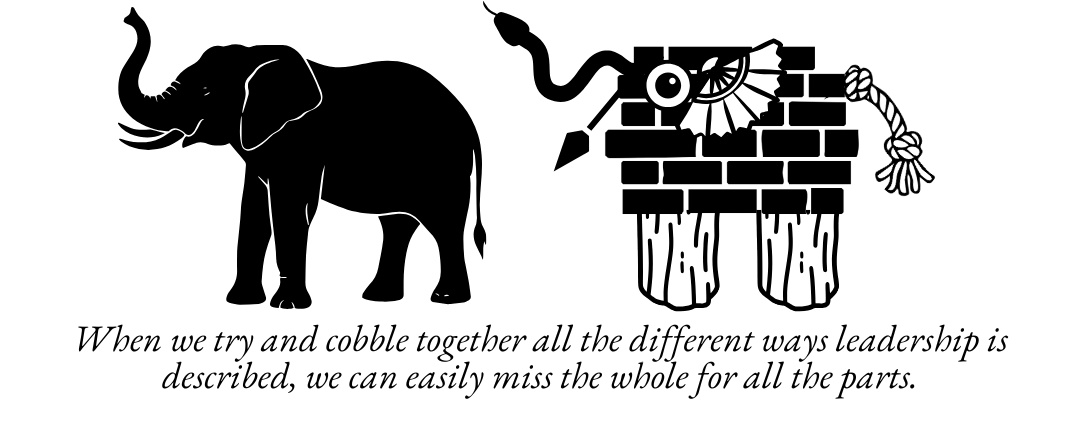
It's like cobbling together bricks, rope, and fan blades and expecting an elephant. You end up with parts that don't add up to a whole.
In Craft: The Expedition of Business, I make an argument that reframes the entire conversation:
Business leadership is a means, not an end. It is a strategic choice in the service of business goals.
We can have a business without leadership. I don't recommend it, but some current and many more failed businesses have unknowingly given it a try. The decision to instill effective leadership is a choice — a good one — but it's an option in service of something larger. Once we see leadership that way, the question shifts from "what traits should I display?" to "what does my organization need me to provide?"
Business Leadership Is Its Own Thing
Most of what we think we know about leadership comes from contexts that don't match the one we're actually in. We mimic sports coaches, military commanders, historical figures — and then wonder why it doesn't translate.
The reason is that business leadership operates in a specific quadrant defined by two variables: the complexity of the situation and the agency of the people being led.

A sports coach works in a world of defined rules, set playing fields, and clear win conditions — lower complexity. But they need their players to think and act independently — high agency.
A cult leader navigates high complexity — making sense of life's biggest questions — but suppresses agency entirely. Obedience is the point.
Business leadership sits in the upper right: high complexity and high agency. The world is messy and uncertain, and you need your team making good decisions without you in the room.
Business leadership is specifically about leading individuals of high agency in a situation of high complexity.
That combination is what makes business leadership its own craft. And it tells us exactly what leadership needs to provide.
Clarity and Order
If leadership is a means in service of business goals, then the question becomes: what does it produce? The answer is two things.
Leadership provides clarity in the face of external confusion and order in the face of internal chaos.
Clarity means standing in the gap between your team and the uncertain world outside. Where are we going? Why? What's the plan? A warehouse manager gathering their team during COVID-era supply chain chaos and saying "We can't control the delays — here's what we CAN control" is providing clarity. It doesn't require a stage or a famous company. It requires a leader who knows what their organization needs to hear.

Order means creating the structure that allows people to do their work with confidence. Clear expectations, consistent standards, accessible information, and accountability when things go off the rails.
Think of it like setting gates along a ski course. Too many gates and you're micromanaging — frustrating the high-agency people you depend on. Too few and it's chaos — everyone skiing different lines to different endpoints.

Our job as leaders is to determine the finish line and figure out how many gates to put along the course. The ask of our teams is then clear: "Get to the finish line, make sure you go through these gates. But for the rest of the run, do as you see fit."
That's leadership rooted in purpose. Not a list of attributes to perform, but a clear function to fulfill.
Why Leaders Are Chosen
Clarity and order are the product. But before anyone experiences your leadership, they have to decide you're worth following.
Research on social perception consistently shows that when we evaluate leaders, we're asking two primal questions: Does this person have my best interests in mind? And are they capable of doing anything about it?
Charisma is displaying warmth first, then strength.
Without warmth, strength becomes threatening. Without strength, warmth is welcome but not reassuring. The leaders people choose to follow are the ones who check both boxes. And the most effective charisma is rooted in truth — you have to actually care, and you have to actually be capable.
Who Leaders Are
If leadership is a means, and its purpose is providing clarity and order, and it requires warmth and strength to attract followers — then what does the actual profile of a good leader look like?
Not what you'd expect. I once took an extensive executive coaching assessment that ranked 25 personal skills. My "leadership" ranking? Number 23 out of 25. And yet I had started, grown, and successfully exited a business with happy employees and anonymous reviews saying "I can't imagine a better boss."
There's no single profile. Effective leadership is one mountain with many paths to the top. But there are traits common to effective leaders regardless of path — four pillars built on one shared foundation.
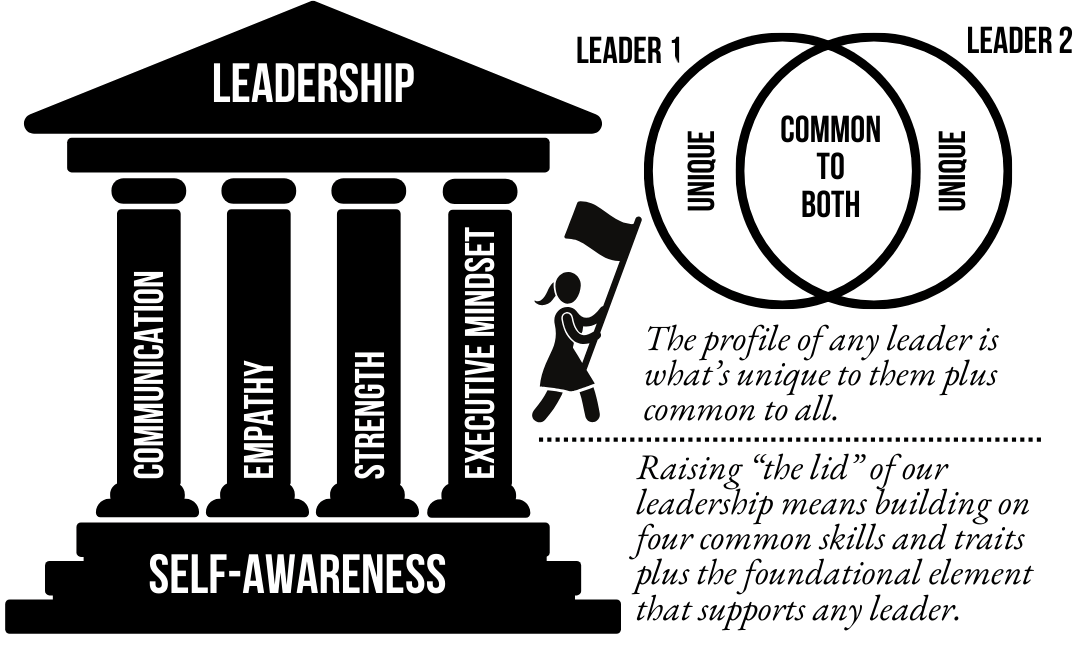
Communication — transmitting your reality to your team's understanding. Not so little detail that they're guessing, not so much that they're overwhelmed.
Empathy — cognitive empathy specifically. The ability to see the world through someone else's experience and use that insight to make better decisions.
Strength — not just one kind. Physical, intellectual, emotional, relational, volitional, and moral strength all play different roles at different times. The goal isn't excellence in one but adequacy in all.
Executive mindset — the ability to zoom in and out across different scales of the business and act at the right level. Not stuck in the weeds, not floating above them, but moving fluidly between the two.
And beneath all four: self-awareness. Without it, none of the others improve. You can't fix your communication if you don't know how you're coming across. You can't develop empathy if you assume others think like you. You can't assess your strength honestly if you only see where you're confident.

The path isn't a straight line. Most leaders improve quickly early on, hit the false summit of Mount Stupid, tumble into the Valley of Realization, and only then begin the real climb toward mastery.
Traits Without Infrastructure Is How Good Leaders Fail
I've met business owners who had every trait on the list. Empathetic, strong, self-aware, great communicators. And their businesses were still struggling — because the leader was the only thing holding it all together. Every decision ran through them. Every fire got put out by them personally. Every new employee learned how things worked by asking them directly.
They had the traits. They didn't have the systems. And when they burned out, got sick, or simply couldn't be in three places at once, the organization stalled.
Because if leadership is a means in service of business goals, then personal traits are only half of what's required. The other half is what you build. Sound decision-making frameworks so your judgment scales beyond your personal bandwidth. A deep understanding of what actually drives the people on your team. And the organizational systems and structures that keep things running when you're not in the room.
Teams can only perform at the level of competence their leaders are able to provide.
The traits tell you who a good leader is. The frameworks, people insights, and systems tell you what a good leader builds. Without both, leadership stays personal — and personal doesn't scale.
Raising the lid of your leadership is a lifelong pursuit. But the alternative is a business that plateaus at the limits of the person at the top. And good people don't stay long in organizations that can't grow past their leader.
Continue the Climb
Want to see how your leadership stacks up against the principles in this article? Take a short, free assessment to surface where your leadership is on autopilot, where it's principled, and where the highest-leverage climbs are next.
Take the Free AssessmentRelated Reading
The Mountain of Why
Why most business owners copy what worked for someone else — and a five-level framework for thinking your way to better answers instead.
Not All Decisions Are Created Equal
A better framework for business decision making — separating the decisions that set direction from the ones that just keep the lights on.
Building Company Culture That Actually Works
Company culture isn't a list of values on a wall — it's the story running through your organization. Here's how to build one your team actually believes in.
How to Motivate Employees (Hint: You Probably Can't)
You can't motivate employees with incentives alone. Here's what actually drives engagement — and how to build an environment where people motivate themselves.
How to Stop Being the Bottleneck in Your Own Business
The way to scale your business isn't working harder — it's building systems where your input produces results far beyond your effort. Here's how to stop being the bottleneck.