From the Book — Craft: The Expedition of Business
How to Motivate Employees (Hint: You Probably Can't)
Stop fueling the machine — start designing the conditions
By Zack Tomlin
Most advice on employee engagement starts from the same assumption: that motivation is something a leader gives to their team. Find the right incentive, deliver the right speech, install the right rewards program — and people will perform.
But anyone who's actually managed people knows that's not how it works. You can offer bonuses, throw pizza parties, hand out gift cards, and plaster "Employee of the Month" plaques on the wall. Some people respond. Most shrug. And the ones you really want to keep — the ones with options — are rarely motivated by any of it.
The problem isn't that leaders aren't trying hard enough. It's that the entire framing is wrong.
In Craft: The Expedition of Business, I build the case around a principle that changed how I lead:
People are very good at doing what they want to do, and not so good at doing what they don't want to do.
That's not a complaint about work ethic. It's a fact about human nature. And once you accept it, the question shifts from "how do I motivate my team?" to something far more useful: "how do I build an environment where what people naturally want to do aligns with what the business needs?"
What People Actually Want
If you ask employees what they want, most will say more money. It's not that they're wrong — more money is always welcome. But as Susan Fowler writes in Why Motivating People Doesn't Work... and What Does:
People don't understand the nature of their own motivation, so when they are unhappy at work, they ask for more money. They yearn for something different — but they don't know what it is — so they ask for the most obvious incentive: money.
Money doesn't solve the real issue. It's their best guess at what will. They know something is off. They feel dissatisfied. But naming the actual source is harder than pointing at their paycheck.
The opportunity for leaders isn't in asking people what they want. It's in understanding what drives them — even when they can't articulate it themselves. A plant doesn't know it needs phosphorus-rich soil and twelve hours of sunlight. It just grows or it doesn't. Our job as leaders is to architect the conditions where people grow.
So what are those conditions?
For most of human history, surviving meant being part of a group. Our distant ancestors didn't have agriculture, running water, or grocery stores. Survival meant being part of a tribe — and being valuable enough to that tribe to stay in it.

Evolutionary psychologist David Buss makes the case in Evolutionary Psychology: The New Science of the Mind that many of our workplace desires — certainty, belonging, competence — trace back to mechanisms that kept our ancestors alive. That wiring hasn't changed. We're still looking for the same things at work that our ancestors looked for in their bands of 30 to 50 people. In the book, I call them the five poles of the Tent of Comfort:
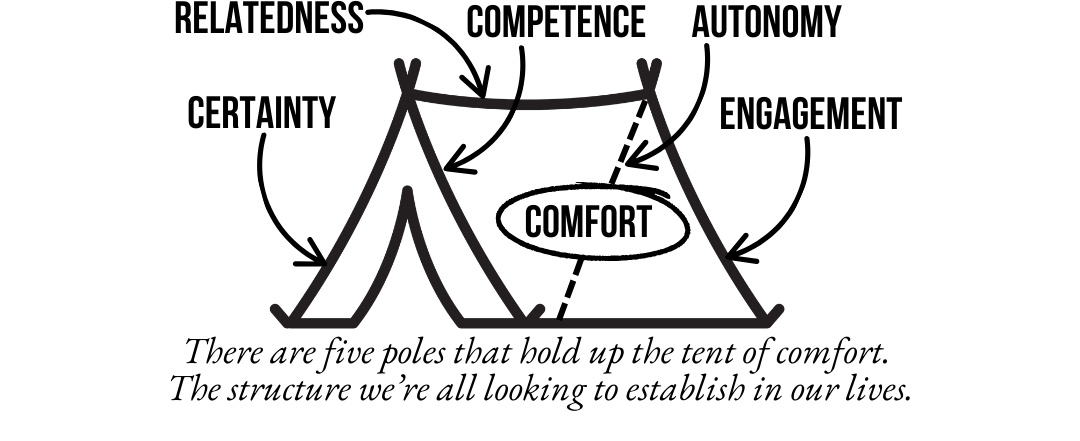
Certainty — Do I know what's expected of me? Do I understand how decisions are made and what success looks like? Uncertainty causes our brains to work overtime. Employees who don't know spend energy worrying instead of working.
Competence — Can I do good work here? Am I recognized for it? We all want to feel capable, and we get uncomfortable when we feel like we're falling behind — possibly becoming a liability rather than an asset to the group.
Autonomy — Do I have control over how I do my work? I've looked for years, but I have yet to find an employee who likes to be micromanaged. We want the freedom to take on challenges our own way.
Relatedness — Am I part of something? Who has my back? More than anything, relatedness is about the question: "What is my safety net?" We are ridiculously social creatures — so social that even for the most antisocial among us, isolation borders on punishment.
Engagement — Am I challenged? Am I growing? No one wants to be bored. Our ancestors faced constant problems requiring creativity and adaptation. Those with a bias toward action and improvement had an advantage. Today, that same wiring makes us miserable when our work feels stale.
These aren't soft concepts. In First, Break All the Rules, Marcus Buckingham and Curt Coffman used Gallup survey data from 80,000 managers across 400 companies to identify the conditions that best predicted employee engagement and high performance. Their findings pointed to the same five conditions — clear expectations, opportunity to use strengths, meaningful connections, regular feedback, and autonomy. Two completely different paths, one from evolutionary first principles and one from massive empirical data, leading to the same destination.
Why Most Engagement Strategies Miss
Most employee engagement strategies target one or two of these conditions and ignore the rest. A company invests in team-building events (relatedness) but leaves expectations unclear (certainty). Another offers professional development (competence, engagement) but micromanages every project (autonomy). A third pays well above market rate but has no clear mission and a revolving door of leadership priorities — leaving people well-compensated but adrift.
The conditions work as a system. Strengthening one while neglecting another doesn't produce engagement — it produces confusion.
I learned this the hard way. I once hired a director of operations. Great credentials, incredibly smart, true team player. He took directions and ran with them. Appreciation was shown publicly, privately, and financially. Eighteen months in, he was ready to quit.
What was missing wasn't money or recognition. It was relatedness and certainty. His role had him working alone most of the time, and without clear metrics, he had no way of knowing if he was succeeding. Some people would manage fine in those circumstances. For him, the isolation and ambiguity were draining.
The fix didn't require more compensation or a new title. We restructured his role to include projects involving a team. Together we built a dashboard that tracked the metrics he was responsible for. His environment changed. Within six months, he was happier and more productive than ever — and he stayed for years.
It was a small adjustment to the conditions. But it made the difference between losing a key employee and having one who thrived.
Machines vs. Ecosystems
There's a deeper problem with how most businesses approach motivation. The default metaphor for an organization is a machine — hire the right parts, assemble them correctly, fuel the system, and it produces output. When something breaks, replace the part. When output drops, add more fuel.
But machines require constant input. They run down. They need someone to keep cranking. And that's exactly what many business leaders experience — the never-ending feeling of pushing, fueling, and pleading with an organization that won't run under its own power.
The problem begins when we set out to build a "well-oiled machine," believing that we only need "more horsepower" and to "fine-tune the operation," because then, once we "grease the rails" and "streamline the process," we'll finally be "firing on all cylinders." But again — the metaphors are wrong.
People aren't mechanical parts. They're living organisms. And like any living thing, they don't need to be fueled — they need the right conditions to grow.

I grew up in North Carolina where summer gardens were the norm. A handful of tomato plants would have my family with more than we knew what to do with by late summer. The question wasn't "are we going to have enough tomatoes?" It was "what are we going to do with all these tomatoes?"
That's the difference between a machine and an ecosystem. One requires constant input. The other produces abundance — when the conditions are right.
The Real Job
The question was never "how do I motivate my employees?" It was always "what conditions am I creating — and are they the right ones?"
That means understanding each person on your team — not just their skills and experience, but what drives them, where they struggle, and what conditions bring out their best work. It means accepting that the same role, the same office, the same compensation can produce completely different results depending on who's in it and what they need.
When we see people as living organisms in need of the right conditions to thrive, our teams can become the lifeblood of an organization. People no longer just complete tasks; they create ways to improve processes; they solve not only their problems but help others with theirs.
That's not motivation. That's what happens when you stop fighting human nature and start designing for it.

Continue the Climb
Want to see whether your team is set up to be self-sustaining or quietly running on fumes? Take a short, free assessment to surface where motivation is bought, where it's built, and where the highest-leverage climbs are next.
Take the Free AssessmentRelated Reading
The Mountain of Why
Why most business owners copy what worked for someone else — and a five-level framework for thinking your way to better answers instead.
Not All Decisions Are Created Equal
A better framework for business decision making — separating the decisions that set direction from the ones that just keep the lights on.
What Makes a Good Leader?
A practitioner's take on business leadership — why the usual list of traits falls short, and what leadership is actually for.
Building Company Culture That Actually Works
Company culture isn't a list of values on a wall — it's the story running through your organization. Here's how to build one your team actually believes in.
How to Stop Being the Bottleneck in Your Own Business
The way to scale your business isn't working harder — it's building systems where your input produces results far beyond your effort. Here's how to stop being the bottleneck.